
Metal Injection Molding (MIM) has emerged as a revolutionary manufacturing process, combining the versatility of plastic injection molding with the strength of metal components. MIM parts have become an essential choice in industries ranging from automotive to medical devices, providing high precision, durability, and design flexibility. Understanding MIM parts is critical for engineers, designers, and procurement specialists seeking to optimize production and enhance product performance.
What Are MIM Parts?
MIM parts are components created using Metal Injection Molding, a process that allows the production of complex shapes that would be challenging or expensive to make with traditional machining or casting. The process starts with fine metal powders mixed with a binder to form a feedstock, which is then injected into molds under high pressure. Once molded, the parts undergo debinding to remove the binder, followed by sintering at high temperatures to fuse the metal particles into a solid, dense component.
This method allows manufacturers to create intricate geometries with excellent surface finishes and minimal post-processing requirements. MIM parts can be produced from a wide variety of metals, including stainless steel, titanium, and cobalt-chrome alloys, making them suitable for high-performance applications.
The MIM Manufacturing Process
Understanding the MIM manufacturing process is essential to appreciating the advantages of MIM parts. The process involves four main stages: feedstock preparation, injection molding, debinding, and sintering.
Feedstock Preparation
The first step in producing MIM parts is creating the feedstock. Fine metal powders are mixed with a thermoplastic binder to form a homogeneous mixture. This mixture must have the correct flow properties to ensure it fills the mold completely without defects. The quality of the feedstock directly impacts the density, strength, and surface finish of the final component.
Injection Molding
Once the feedstock is prepared, it is injected into a mold under high pressure, similar to plastic injection molding. This stage allows for precise replication of intricate designs, thin walls, and small features. MIM parts can achieve tolerances as tight as ±0.1 mm, making them ideal for applications that demand precision.
Debinding
After molding, the binder must be removed. Debinding is typically done using solvent or thermal processes to extract the binder without damaging the part. This stage is critical because residual binder can compromise the mechanical properties of MIM parts. Proper debinding ensures the parts are structurally sound and ready for sintering.
Sintering
The final step is sintering, where the debound parts are heated to a temperature below the melting point of the metal. During sintering, metal particles fuse together, resulting in a dense, strong component with excellent mechanical properties. The sintering process also reduces shrinkage and distortion, ensuring MIM parts meet the desired specifications.
Advantages of MIM Parts
MIM parts offer several benefits that make them an attractive option for modern manufacturing. Some of the key advantages include:
Complex Geometries
One of the most significant advantages of MIM parts is the ability to produce complex geometries that would be difficult or impossible with traditional machining. Features such as internal channels, thin walls, and intricate shapes can be manufactured with high precision, reducing assembly requirements and improving overall design flexibility.
Material Versatility
MIM parts can be produced using a wide range of metals, including stainless steel, titanium, and nickel-based alloys. This versatility allows engineers to select materials based on specific mechanical, thermal, or corrosion-resistant requirements, making MIM parts suitable for demanding applications in aerospace, medical, and automotive industries.
High Precision and Consistency
The MIM process ensures consistent part quality, with tight tolerances and minimal variation between batches. This precision reduces the need for secondary machining and finishing, lowering production costs and lead times.
Cost-Effective for High Volume Production
Although the initial tooling cost for MIM parts may be higher than traditional machining, the process becomes highly cost-effective for large production runs. MIM parts can be produced rapidly and with minimal material waste, making them ideal for mass production of small to medium-sized components.
Applications of MIM Parts
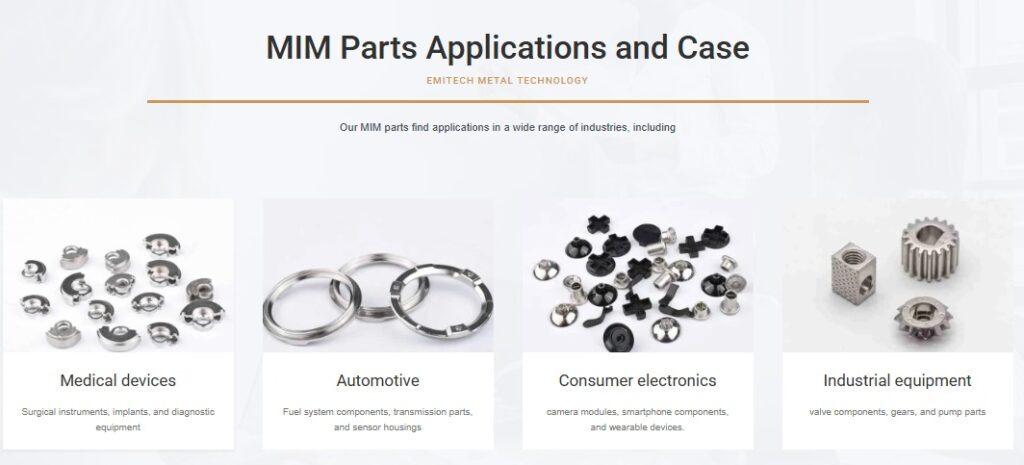
The unique properties of MIM parts make them suitable for a wide range of applications across various industries.
Automotive Industry
In the automotive sector, MIM parts are used for components such as gears, fuel injection nozzles, and sensors. The ability to produce high-strength, lightweight components with complex geometries helps improve fuel efficiency and performance.
Medical Devices
MIM parts are widely used in the medical industry for surgical instruments, implants, and orthopedic devices. The precision and material versatility of MIM parts ensure reliability and biocompatibility, which are critical in healthcare applications.
Electronics and Consumer Goods
MIM parts are also used in electronics for connectors, housings, and precision components. In consumer goods, MIM parts enable intricate designs in products such as watches, tools, and small appliances, combining aesthetics with functional durability.
Aerospace and Defense
The aerospace and defense industries benefit from the high-performance characteristics of MIM parts. Components used in aircraft engines, weapon systems, and satellites require exceptional strength, thermal resistance, and precision, all of which MIM parts can provide.
Challenges in MIM Parts Production
While MIM parts offer numerous advantages, there are challenges to consider during production.
Material Limitations
Not all metals are suitable for MIM, and some high-melting-point metals may require specialized sintering equipment. Choosing the right material is essential to achieving the desired mechanical properties and performance.
Design Considerations
Although MIM allows for complex geometries, designers must consider factors such as shrinkage, wall thickness, and feature placement. Improper design can lead to defects such as warping, porosity, or incomplete filling of the mold.
Cost of Tooling
Initial tooling costs for MIM parts can be high, making the process less economical for low-volume production. However, these costs are offset in large-scale manufacturing due to reduced material waste and faster production times.
Future of MIM Parts
The future of MIM parts looks promising, with ongoing advancements in materials, process optimization, and additive manufacturing integration. Researchers are exploring hybrid approaches that combine MIM with 3D printing to create even more complex and lightweight components. Additionally, innovations in powder metallurgy and binder technology are expanding the range of materials and improving the mechanical properties of MIM parts.
As industries continue to demand high-precision, cost-effective, and durable components, MIM parts will play an increasingly vital role in modern manufacturing. Their versatility, efficiency, and performance make them a preferred choice for engineers and designers looking to push the boundaries of product innovation.
Conclusion
Understanding MIM parts is essential for leveraging their full potential in various industries. From the detailed manufacturing process to their diverse applications, MIM parts offer a unique combination of complexity, precision, and material versatility. While challenges such as tooling costs and material limitations exist, the benefits often outweigh these obstacles, especially in high-volume production.
As technology advances, MIM parts will continue to evolve, offering even more opportunities for innovative design and efficient manufacturing. Whether in automotive, medical, aerospace, or consumer goods, MIM parts are redefining the possibilities of metal component manufacturing, making them a cornerstone of modern industrial engineering.
MIM parts represent a fusion of advanced materials science and manufacturing ingenuity, offering solutions that traditional methods simply cannot match. By understanding the process, advantages, and applications of MIM parts, industries can fully harness their potential to create high-performance, cost-effective, and intricately designed components.
